A favorite destination for tourists from all over the world, Venice is known for its fine glassmaking, its colorful carnival and its peculiarity as a “city in water”. Gondolas, bridges, markets, monuments, a beautiful square: all this and more is Venice.
Ready to discover the 10 must-sees in the capital of Veneto? Arm yourself with comfortable shoes and cameras, because Venice reveals its breathtaking beauty in every corner of the city.
The most interesting attractions in Venice to visit in 2023
St Mark’s Square

The true heart of Venice, St Mark’s Square is the center of the city’s culture and modernity. St Mark’s Square, also known as Piazza San Marco, is the main public square in Venice, Italy.
It is one of the most famous and visited attractions in the city, and has been called “the salon of Europe” due to its historical and cultural significance. This vast square, once a large vegetable garden, was transformed when the Basilica of the same name was built to house the relics of St Mark.
Historical monuments such as the Doge’s Palace, the Clock Tower, St Mark’s Bell Tower and the aforementioned Basilica are all located in the square, and the queues to visit these attractions are very long, so a priority ticket* is essential, or better yet, a combined ticket with priority entrance* to the Doge’s Palace and the Basilica to save both time and money.
The square is also home to very “chic” venues, unfortunately not affordable for all budgets. If you don’t have budget problems, take a seat at one of the tables outside the Caffé Florian to watch the life pulsate around St Mark’s Square and enjoy a spectacle that has no equal.
St Mark’s Basilica

St Mark’s Basilica, the ”Golden Basilica,” began as the ducal chapel, the private church of the Doge. The splendid mosaics that cover every part of the interior walls, some 1,000 square meters, are executed in gold tiles produced in Murano with fine 24-karat gold leaf. If the gold were not pure it would darken and not be as brilliant as it is today.
The Basilica was originally built in the 9th century as a chapel for the Doge, the ruler of Venice. Over the centuries it was expanded and embellished, and today it is a complex of buildings that includes the main basilica, a museum, and the Treasury.
Admission to the Basilica is free, but it is worth a small obolus to view both the Pala d’Oro and the Treasure of St Mark’s, which houses a collection of objects composed of gifts made to the doge during the millennium of the Serenissima Republic.
One can see solid gold or Rock Crystal cups, gems, monstrances, reliquaries. In addition, it is possible to go up to the loggia from which one overlooks St Mark’s Square. On the way to it one can view the museum that houses the original bronze Quadriga of St Mark’s Horses that were taken from Constantinople in the 13th century, a copy of which towers over the Basilica’s central door.
There is also an opportunity to purchase a tour of the Basilica that allows you to skip the entrance line and visit its majesty accompanied by a guide. The tour of the Basilica can be booked at link. Finally, if you wish to visit both St Mark’s Basilica and the Doge’s Palace the tour can be reserved here.
Doge’s Palace

A “gothic” witness to the rise, fall and rise of Venice is the Doge’s Palace, home of the Doge and seat of the government of the Serenissima. Located in St Mark’s Square, the palace has suffered numerous fires, but like the Venetian people, it has managed to rise again and shine in its white Istrian stone and pink Veronese marble, right in the center of the main square.
The palace served as the center of Venetian political power for centuries and is famous for its ornate facades, elegant interiors, and historical significance. Today it is a popular museum showcasing the art, history and culture of Venice.
Don’t miss a visit to the palace, but remember that the queues can be quite long, so it is highly recommended to buy a ticket with priority entry*. As with the Basilica, it is ideal to buy a combined ticket* for the Doge’s Palace and St Mark’s Basilica to save money and waiting time.
Rialto Bridge

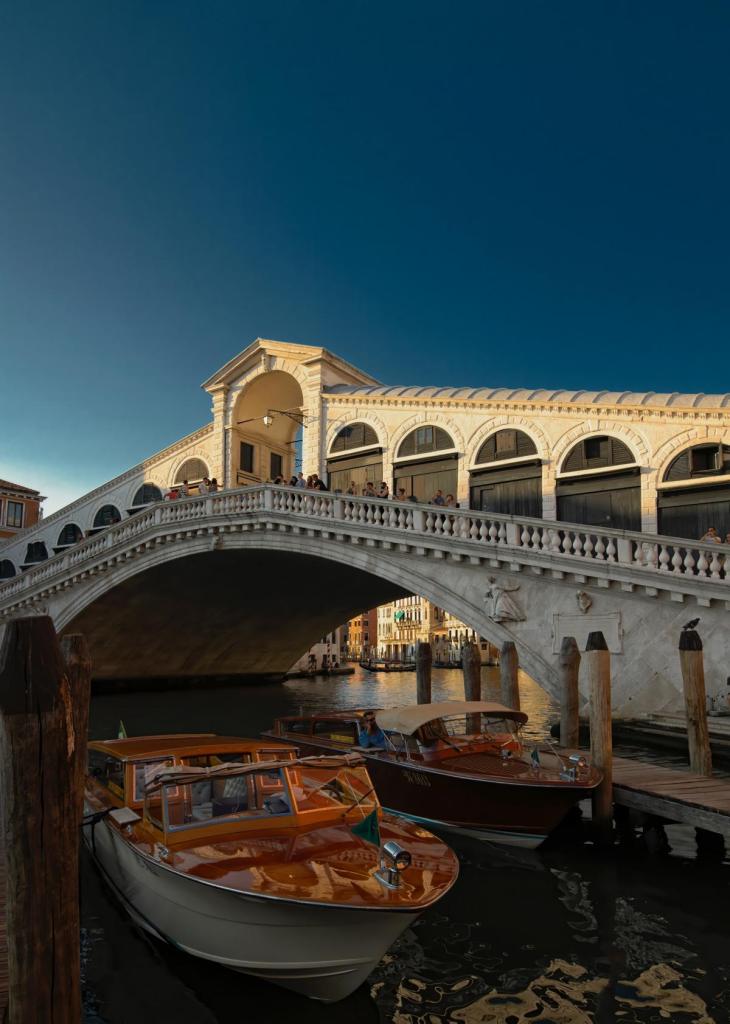
Born before the city itself was the Grand Canal of the Serenissima, “Canalazzo” for the citizens of Venice. The Grand Canal, with its inverted “S” shape, crosses the capital for as much as 4 km, dividing the historic center in half.
It is possible to admire a breathtaking view of the canal from the world-famous Rialto Bridge, a true symbol of the city. Not to be missed is a ride on a traditional gondola, admiring some of the city’s most important monuments from a different perspective; for a super romantic and folkloric experience at the same time, we recommend the gondola tour with music and singers, enjoying one of the most unique experiences you can have in Venice.
Rialto Market

During your stay in Venice, which is mostly characterized by visits to museums, neighborhoods and the most charming districts, reserve a morning for a few hours of shopping at the picturesque Rialto Market!
Known for its fresh produce, seafood and other local specialties, it is a popular destination for both locals and tourists. From gastronomy to textiles, you can find and buy just about anything, perhaps tasting, between a glance at a spice stall and one of oriental silks, some exquisite typical Venetian dishes. The market has been operating for over 700 years and is a vibrant hub of activity and commerce in the heart of Venice.
Of course, you can lose yourself in the colors of the market for free. But if you want an unforgettable tourist experience, book a real food and wine tour* to discover authentic and genuine flavors.
The Canal Grande
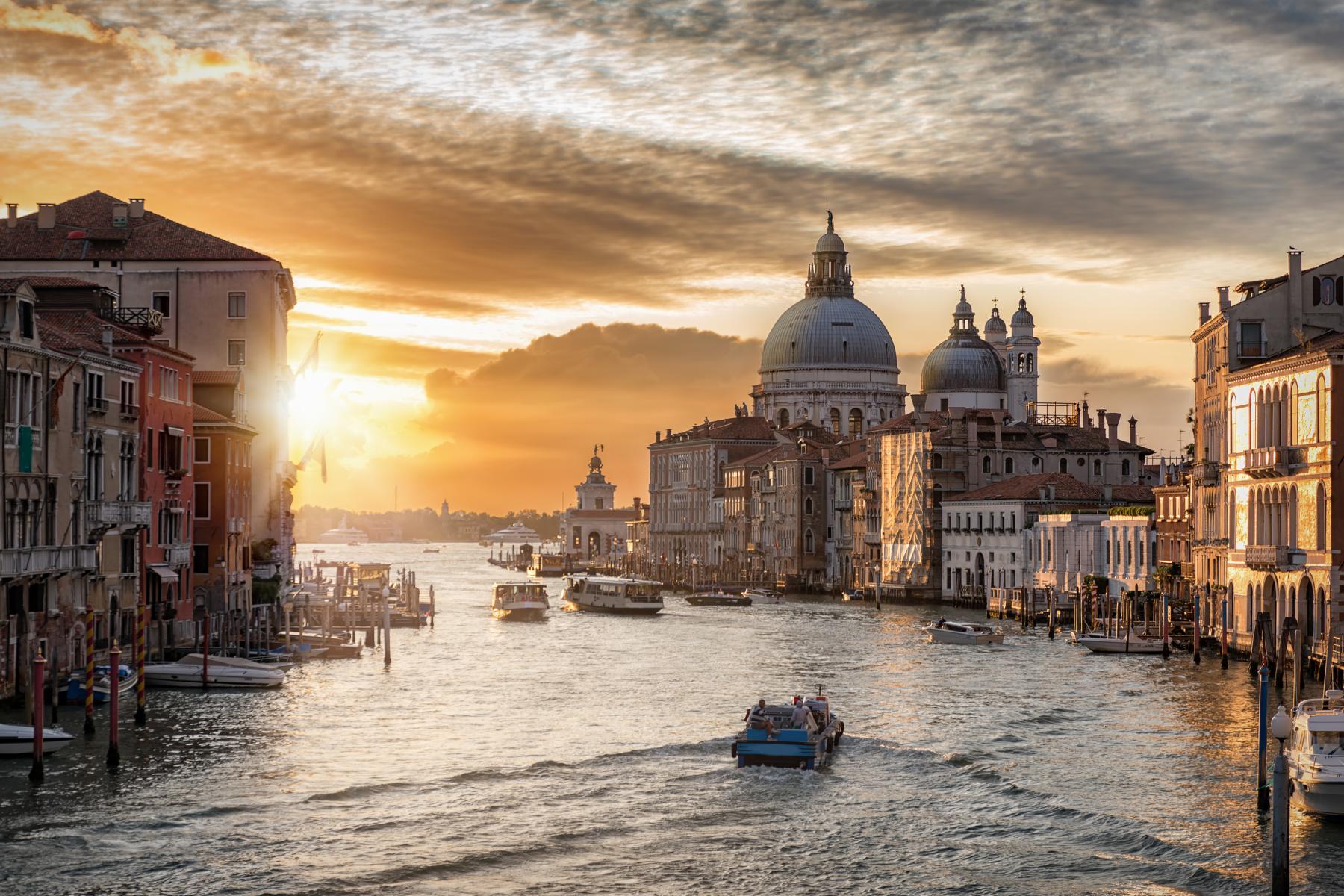
The Canal Grande is the main canal in Venice and is one of the most famous and picturesque waterways in the world. It is approximately 3.8 km long and winds its way through the heart of Venice, passing under several famous bridges and past many historic buildings and palaces. The Canal is a major transportation artery in Venice and a popular destination for tourists who want to experience the city’s unique beauty and charm from the water.
Vaporetto ride on the Grand Canal

A tourist arriving in Venice for the first time is able to fully grasp the beauty of the City only after traveling along the main canal: the Grand Canal.
Grand Venetian palaces are reflected on the banks, majestic churches and some of the city’s important museums overlook the characteristic waterway. It is believed that, in ancient times, the canal was the bed of a river that flowed into the Adriatic, crossing all the islets that would later form the lagoon city, following a winding path in the shape of an inverted S.
The enchantment of the boat trip, a journey immersed in the brackish waters, lies in imagining how the ancient Venetians could have built this marvel, dotted with Monuments and Churches, erecting towering Palazzi and juxtaposing them seamlessly with each other, conceived and designed by the greatest architects of all time – from the 14th to the 19th centuries – in an environment that without the intervention of the Venetians would have remained inhospitable and unhealthy.
You can purchase your 75-minute boat ticket at ticket offices or directly online at this link.
Traghetto ride

Cheap Gondola Tour: Do you dream of riding in a gondola? Know that you can do it for as little as €2.00. Traghetto rides in Venice are a unique and affordable way to cross the Grand Canal by gondola, using traditional methods that have been used in Venice for centuries.
Some Traghetto offer short rides at the following boarding points:
- traghetto Dogana (9am-6pm)
- traghetto Santa Sofia – near Rialto market (9am-6pm)
- traghetto San Tomà (9am-6:30pm)
- traghetto Santa Maria del Giglio (9am-6pm)
- traghetto Carbon (Monday – Friday 9am-12pm)
Of course, the experience has little to do with the classic “gondola ride”, but for the ridiculous price it is definetely worth it…
Authentic Gondola ride

The gondola is the typical Venetian boat. It is about 11 meters long and possesses an asymmetrical shape as it can be driven by only one person, the gondolier.
The gondola is an extremely complex boat to make, its construction takes more than a year, and an additional peculiarity is that it is custom-made to suit the gondolier, his weight and physical characteristics, to allow the boat to glide with unique elegance over the lagoon surface.
Taking the classic gondola ride may seem like a “tourist” experience, however it is an essential activity when visiting Venice, as it allows you to have a different perspective and see places that cannot be discovered by walking around the City, but can only and only be appreciated on board these boats.
You can book your private gondola tour on this link*. Or you will have the opportunity to take a shared gondola tour at this link*.
Jewish Ghetto
The Jewish Ghetto of Venice is one of the oldest and most significant Jewish ghettos in Europe. Established in 1516, it was a segregated area where Jews were required to live and worship in isolation from the rest of the city. Despite these restrictions, the ghetto became a vibrant center of Jewish life and culture, and today it is a fascinating historical and cultural destination that offers a glimpse into the rich heritage of Venetian Jewry.
Another universe apart from the city of Venice. The term “ghetto” has its origin in the Venetian city itself, to apostrophize real “other” quarters, far from the center, both architecturally and culturally.
The Jewish Ghetto is worth a stop for its special houses, designed to accommodate large families, for its three synagogues, because it is a blatant example of successful coexistence between different religious and social “backgrounds”.
A guided visit* to the Jewish Ghetto includes churches, bridges and monuments. Some agencies combine the tour with an excellent gastronomic experience that allows you to taste Venetian specialties in some typical restaurants of the Sestiere of Cannaregio. For more information on the gastronomic tour, click here*.
Gallerie dell’Accademia
The Gallerie dell’Accademia in Venice is one of the most important art museums in Italy, renowned for its collection of Venetian art from the 14th to the 18th centuries.
The Gallerie dell’Accademia is located in a former monastery complex on the south bank of the Grand Canal, one which includes the Church of Santa Maria della Carità, the Convent of the Canonici Lateranensi and the Scuola Grande di Santa Maria della Carità, which houses, among other things, one of Leonardo da Vinci’s most important works, “The Vitruvian Man“, carefully guarded by the curators of the Galleries and rarely exhibited to avoid possible deterioration.
Whether you are an art lover or not, such a rich museum deserves to be visited with a guided tour, which will allow you to get to know the most important works, their stories, anecdotes and, above all, will let you know all the secrets behind the real masterpiece of this museum: the Vitruvian Man by Leonardo da Vinci.
Also, since this is one of the most iconic museum complexes in Venice, there are often long lines at the entrance, so it is best to opt for a skip-the-line ticket*.
La Fenice Theater
“Like the phoenix, you will rise from the ashes” is a saying we often repeat, but it finds its true meaning when talking about the famous Venetian theater, which has been destroyed twice in 200 years, but has always risen again to regain its former glory.
The theater La Fenice has been the stage for some of the most famous operas and composers in history, including works by Verdi, Rossini, and Bellini. It has also hosted some of the world’s greatest singers, conductors, and performers, making it a cultural and artistic center of international renown.
It is possible to learn about the history and curiosities of the theater thanks to a special guided tour* to discover one of the most famous theaters in the world.
Acqua Alta bookshop

A place out of time that fascinates and immerses every visitor in an “other” universe where it is possible to get lost. The Acqua Alta bookshop is known for its eclectic and diverse collection of books, which includes everything from classic literature to contemporary bestsellers, as well as books in several different languages.
The name “Acqua Alta” means “high water” in Italian, and refers to the frequent flooding that occurs in Venice during the winter months. The bookstore is located in a low-lying area of the city that is particularly prone to flooding, and as a result, the owners have come up with some creative ways to protect their books from the water.
The bookstore is also home to several resident cats, who are free to roam around the store and often curl up on the shelves or in the display cases. The cats have become a beloved part of the bookstore’s charm and character.
You only have to walk into this small bookstore to realize that you are looking at something absolutely extraordinary: stacks of books on the most diverse subjects, perfectly arranged on volume-saving gondolas during floods. A dream come true.